
Improve Inventory-Aware Pathfinding with Map Preprocessing
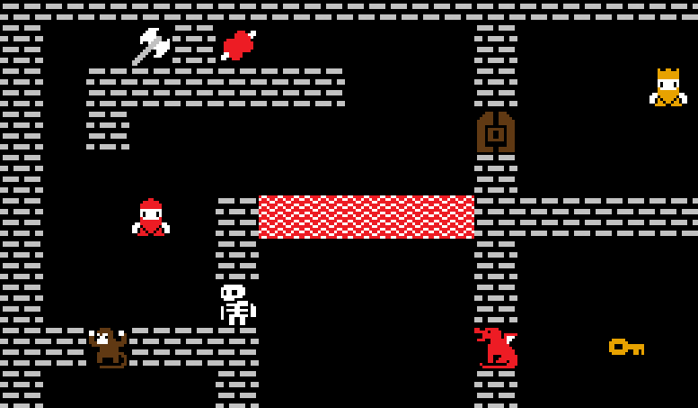
This article has been originally published on Gamasutra.
In the last article we introduced a basic approach for Inventory-Aware Pathfinding (IAP), a pathfinding algorithm capable of interacting with obstacles and not just avoiding them. If you have not read it, I encourage you to go back and read it to understand the basic challenges and the main ideas behind the proposed solution.
For instance, we can have a pathfinding algorithm that can solve small plans and “puzzles” involving reasoning like “before passing this door, I need to get that key”. This is definitely planning territory. However, if we focus on a small subset of the problem, we may squeeze the algorithm into the pathfinding search itself.
Inventory-Aware Pathfinding - Part 1
Everybody know what pathfinding is. I don’t think I have to explain to a game developers audience why pathfinding is so important in games. If something in your game is moving not in a straight line, then you are using some kind of pathfinding.
What is less evident is that pathfinding is the only place in which “searching” is generally accepted. Except for GOAP and other planning-based techniques, the big part of the NPC’s decision-making techniques are reactive-based.
This is not a bad thing. Reactive techniques are an amazing design tool. However, this raises a question. Why is this? Mainly because of computational limits - full-fledged planning still requires an impractical amount of time - but also because of design unpredictability. The output of planning decision-making techniques is hard to control and the final behavior of the agent could be counterintuitive for the designers and, at the end, for the players.
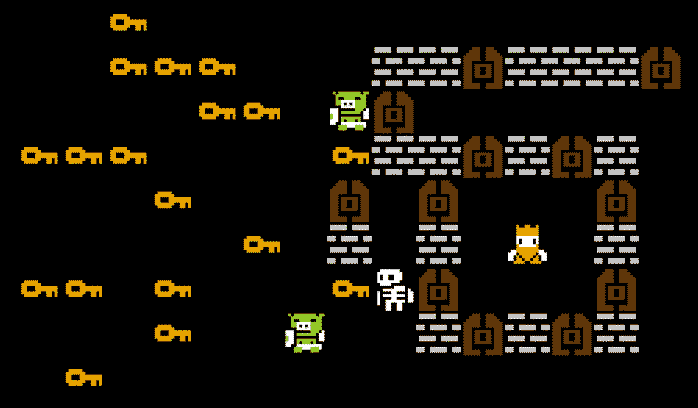
Why can pathfinding play a role in this? Because it is possible to embed in it a minimal, specialized, subset of planning, especially if these planning instances require spatial reasoning. A common example is solving a pathfinding problem in which areas of the map are blocked by doors that can be open by switches or keys sparse around on the map. How can we solve this kind of problems?